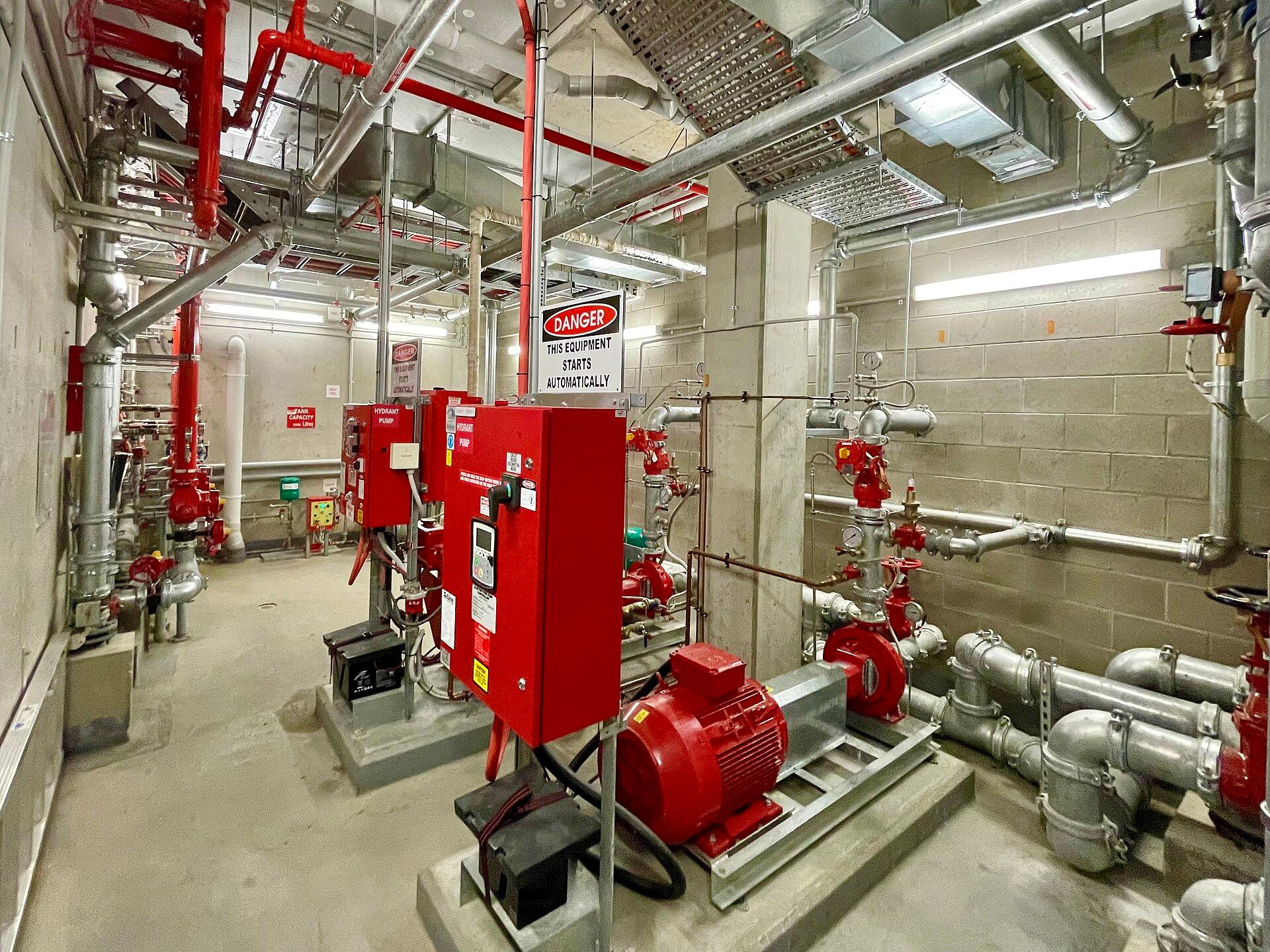
A sprinkler system that was designed correctly and commissioned last decade is not, by itself, a fire system you can rely on this afternoon. Valves get shut. Heads get painted during a fitout. Pumps sit in auto until someone switches them to off and forgets. AS 1851 exists because Australian buildings treat fire protection as an essential safety measure that has to be kept capable of working, not as a one-off construction product. This piece, in the maintenance and inspection hub, is about the standard, the people, the paper and the money. The visits themselves are in weekly, monthly and annual fire sprinkler tests explained. How to read what comes back is a separate guide.
What is AS 1851?
AS 1851 is the Australian Standard for the routine service of fire protection systems and equipment. It is the document service contractors quote when they talk about weekly alarm tests, monthly pump runs and yearly surveys. It is not the document that tells you whether a building needs sprinklers in the first place, and it is not the hydraulic design standard. Those jobs sit with the National Construction Code and the AS 2118 series, which we cover under standards and compliance.
What AS 1851 does is take an installed system and ask, at set frequencies, whether it is still in a condition to perform. Inspection, testing, preventive maintenance, survey and record-keeping are all part of that. For sprinklers that means looking at control valves, water supplies, pumps, alarm devices, pipework and heads, and writing down what was found against a baseline.
The standard is written for owners and occupiers as much as for technicians. The frequencies live in the standard. They are not a menu. An owner cannot invent a cheaper calendar because the warehouse had a quiet year, and a contractor cannot skip a survey because the valve-room visit already took an hour. AS 1851 also covers hydrants, hose reels, detection, extinguishers and fire doors. Sprinklers are one chapter of a building-wide regime. Treating the sprinkler contractor as the only fire person on site is how occupancy statements come unstuck.
Routine service versus survey
People use “service” to mean everything a contractor does on site. AS 1851 is more particular.
Routine service is the repeating work: the weekly trip of the alarm valve, the pump start, the gauge readings, the check that the control valve is actually open and secured, the look at tanks and town-main supplies. It is designed to catch the failures that happen between visits — a shut valve, a failed diesel start, a monitoring fault, a leak that has dropped pressure. Those visits are short on purpose. They are not a substitute for walking the floors.
A survey is a wider look at the installation itself. Survey work is how you find painted heads in a tenancy that was refurbished six months ago, storage stacked into the discharge pattern, a new mezzanine that nobody told the fire contractor about, corrosion on exposed pipe, missing spare heads, or an obstructed fire-brigade booster. A weekly test can pass while a survey would fail the building. That is not a contradiction. They are looking at different things.
If you only ever pay for the short weekly visit, you are maintaining the alarm path and perhaps the pumps, and hoping the rest still matches the drawings. Hope is not a maintenance method. Occupancy changes faster than pipework: tenants fit out, warehouse layouts creep, painters treat a deflector as ceiling furniture. None of that shows up on a valve-room gauge. Routine tests answer whether the system would know it was flowing and whether the pumps would start. Surveys answer whether the certified system is still the one on the ceiling. You need both. The calendar is in AS 1851, not in a contractor’s flyer.
Logbooks, occupancy certificates and the AFSS
AS 1851 expects records. On a well-run site that means a logbook or electronic equivalent that stays with the building, not in a contractor’s van and not only in a portal that dies when you change contractors. Baseline data from commissioning — static and running pressures, pump performance, water-supply details, the location of isolation valves — is what later readings are compared against. If those figures were never captured, every later report is a snapshot without a reference.
Those records are not a courtesy to the next technician. They are how an owner shows a regulator, an insurer, a certifier or a purchaser that the essential safety measures have been kept. The legal wrapper changes by state.
In New South Wales the familiar document is the Annual Fire Safety Statement. The owner, or the owner’s corporation, must obtain statements from competent practitioners that each essential fire safety measure is capable of performing to the standard listed on the fire safety schedule. Sprinklers, where they are a listed measure, sit on that list. A year of missing sprinkler records is not a paperwork inconvenience. It is a problem for the AFSS, and it is a problem for anyone who later has to stand behind that statement.
Other states use occupancy certificates, essential safety measure reports, occupier statements or annual inspection certificates. Queensland occupiers have duties under building fire-safety regulation to maintain fire safety installations. Victoria ties essential safety measures to the occupancy permit and expects annual reporting. Western Australia, South Australia, Tasmania, the ACT and the Northern Territory each have their own occupancy and maintenance language. The names differ. The idea does not: the occupancy permission you were given assumed the fire systems would be maintained, and AS 1851 is the usual method of proving it.
A report that says “all ok” with no pressures, no defects list and no statement of which frequencies were performed is weak evidence. Read it as if you might have to explain it. If you cannot, sit with the guide to reading a sprinkler service report. Keep as-installed drawings or block plans, and the last survey, on site. Technicians should not reconstruct the system from memory at the pump-room door.
Who is the competent person, and who pays for access
AS 1851 work is to be done by a competent person. Competence is a mix of training, qualifications and experience on the type of system in front of you. Fire Protection Association Australia accreditation for inspect-and-test work, state contractor licensing, and in some jurisdictions fire-safety practitioner schemes, are how the market usually demonstrates that. A general handyman who can bleed a radiator is not, by that fact, competent to isolate an alarm valve or to sign a yearly survey.
The building owner or occupier remains responsible for seeing that the work happens. You can contract it out. You cannot contract the duty away. If the contractor cannot get into a locked tenancy, a roof plant room, a basement pump room or a ceiling space, the service is incomplete. The owner has to fund access: keys, escorts, after-hours attendance, moving of stock so heads can be seen, a scissor lift where the survey needs one. “We could not get in” is a defect in the maintenance program, not an excuse that makes the system compliant.
A technician told “just do the valve room, the warehouse is picking” will do the valve room. The report should then say the warehouse was not surveyed. If it does not, and the warehouse later has coated heads and a closed branch valve, the paper trail will not save anyone. Paying for access is part of paying for AS 1851.
Who may design and certify a new system is a different question. That sits with the people in who can design and certify fire sprinklers in Australia. Maintenance competence is not a licence to redesign the system. If a survey finds occupancy has outgrown the original design — high-piled storage under a light-hazard ceiling, for example — that is a design problem. The service person should raise it, not quietly “make it work” from the spares cabinet.
What owners should not skip
The frequencies are in the standard. The owner funds the access. The competent person does the work. The logbook is how you prove it.
Skipping a year because “nothing happened” is the most common private exemption people invent. A quiet year is not evidence that an alarm valve would have moved, a diesel would have started, or that a tenant did not paint a row of heads. Sprinkler systems fail most often because they were isolated, obstructed or starved of water. Catch-up visits can test what is in front of the technician that day. They cannot honestly backfill fifty-two weekly tests that were never done, and they cannot restore the occupancy-statement chain you let lapse.
Vacant buildings are not an exemption either. They have their own fire and impairment problems, and insurers tend to notice. If a floor is isolated for a fitout, that is a planned impairment with a start, a finish and a restoration — see isolating, draining and restoring a sprinkler system safely — not a holiday from the standard. Maintenance is a regime you keep, not a product you buy once.