A sprinkler service report is not a receipt. It is the only contemporaneous account of whether the system you are responsible for was capable of working on a given morning. Occupancy certificates, the Annual Fire Safety Statement, insurers and the next technician will all treat it as evidence. If you file it unread, you have agreed to a story you have not checked.
This guide is for the building manager who gets the PDF at 4 p.m. and has a meeting at 4:30. It sits in maintenance and inspection with AS 1851 and the test calendar. It will not make you a hydraulic designer. It will stop you signing a pass that is actually a fail.
What a competent sprinkler service report contains
Look first at identity, not at the tick boxes. The report should name the building, the system (wet, dry, combined, which valve set, which pump), the frequency that was actually performed, the date and time, and the competent person. “Sprinklers — service” is not a frequency. Weekly alarm test, monthly pump test, six-monthly survey and yearly survey are frequencies. If the header says yearly and the body only lists a valve-room visit, the header is wrong.
A competent report records readings against a baseline: static and residual or running pressures, tank levels, pump start and stop pressures, which selector position the pump was left in. It lists areas accessed and areas not accessed. It lists defects with a location you could walk to, not “heads throughout”. It says whether any part of the system is isolated or impaired on departure. It names outstanding items from the last visit.
If any of that is missing, the report is thin. Thin reports are how last year’s closed valve becomes this year’s mystery. They are also weak evidence for an AFSS or an essential-safety-measure statement. You are entitled to ask the contractor to write the visit they actually did.
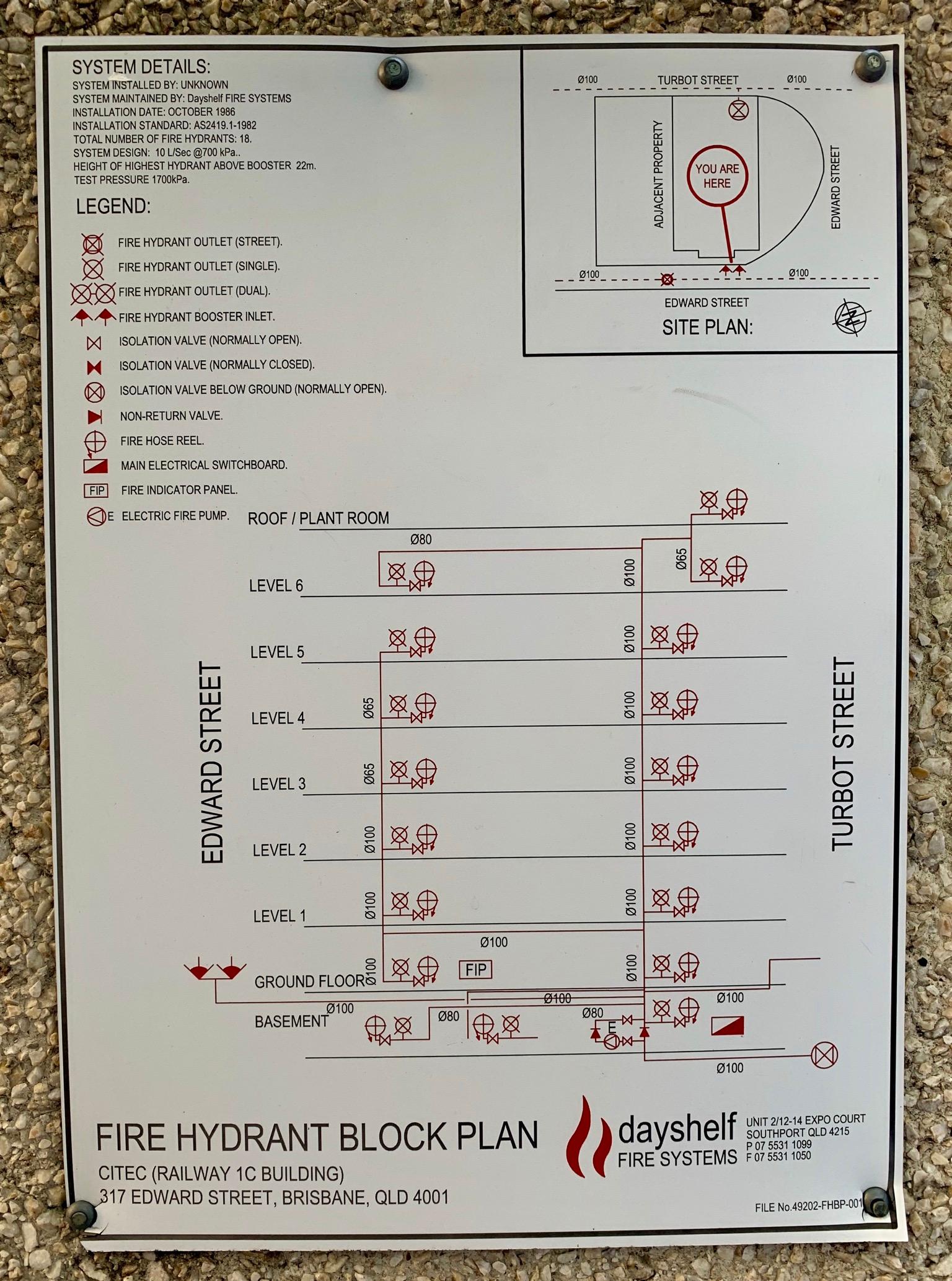
Drawings and block plans are part of the same pack even when they are on the wall rather than in the PDF. If the report refers to “valve V3” and you cannot find V3 on the plan in the pump room, the document is already arguing with the building.
Defect severity language and tags
Contractors do not share a single Australian dialect for defects. You will see priority 1 / 2 / 3, critical / non-critical, immediate / 24 hour / 30 day, P1 / P2, and sometimes a simple pass/fail against AS 1851. Priority 1, or critical, or immediate, almost always means the system may not perform as designed until the item is fixed. Treat it as an impairment of the fire measure, not as a maintenance suggestion.
A missing spare head is not the same kind of sentence as a shut suction valve. If the report flattens both into “non-conformance”, ask for a split: things that stop the system working, things that will, and things that are housekeeping. The common defects article is the field guide to what those things usually are.
Tags on valves and devices are a second language. They are not a national colour code. Some contractors use red for isolated, yellow for impaired or caution, green for restored. Others use yellow for everything that is not normal. Some buildings inherit tags from three previous contractors and never take the old ones off. A yellow tag is not the same everywhere. Read the legend on the report, read the writing on the tag, and if they disagree, believe neither until someone competent stands in front of the valve.
Do not remove a tag because it looks untidy. Removing a tag is how an isolation becomes undocumented. If a tag is stale — a three-month-old “temporary isolation” — that is a defect in the impairment program, and it should be on the report.
Isolated versus impaired
These words get used as synonyms. They are not.
Isolated means a valve is shut, a section is drained, or a device is taken out of service so that water cannot flow to that part of the system. An isolated floor is unprotected by sprinklers. That is a planned or unplanned shutdown of a fire measure.
Impaired is the broader word. A system can be impaired without being isolated: painted heads on an otherwise live floor, storage in the discharge pattern, a disabled alarm path, a pump not in auto, a booster the brigade cannot reach. Water might still be in the pipes. The system still cannot be honestly described as capable of performing.
A report should say which it is, which parts of the building are affected, who was notified, and when restoration is expected. “System isolated for works” with no floor, no time and no restoration is not an impairment record. It is a rumour.
If the technician isolated something during the visit — to replace a head, to drain a drop, to stop a leak — the departure condition matters more than the arrival condition. You care whether they left it restored. Restoration is a checklist, not a vibe. The companion piece is isolating, draining and restoring a sprinkler system safely.
When a report says the system is impaired and you do not understand the risk, do not wait for the next monthly visit to think about it. An impaired sprinkler system is a building with a hole in its fire strategy. Fire-watch arrangements, occupant limits, hot-work bans and insurer notification are management decisions. The report is what tells you that you have to make them.
Pressure readings and pump start pressures
Skip the comments and read the numbers first. Static pressure on the installation gauge, pressure on the town-main or tank side, and the pressure at which the pump started are the three figures that most often reveal a problem a tick-box will hide.
Compare them to the last report and to commissioning or baseline data if you have it. A slow slide in static pressure is a leak, a draining test valve, or a supply change. A pump that used to start at one figure and now starts at another is a settings change, a seized device, or a jockey that is no longer doing its job. A pump that did not start during a test because “pressure was already up” may be true; it may also mean the test never dropped pressure far enough to prove the start. Ask.
Jockey or pressure-maintenance pump behaviour belongs in the same paragraph. Short-cycling means water is leaving the system. A jockey that never runs may mean a main pump is sitting on a leak, which is an expensive way to keep pressure up and a good way to wear a fire pump.
If the report has no numbers, it has not recorded a test you can defend. “Pressures normal” is an opinion. A number is a record. For what the weekly and monthly visits are supposed to prove, see the tests explained piece.
What a building manager should do next week
Do not sign a report you cannot explain. A signature is often treated as acknowledgement that the findings reached the responsible person. That can matter for occupancy statements and for arguments about who knew a valve was shut. If you do not understand a line, write that on the page or in the email and ask for a plain-language revision. Do not sign blank. Do not sign “all ok” when the comments describe a defect.
The week after a visit, work the list in order:
- Anything isolated or priority 1: who knows, what compensating measures, what repair date.
- Outstanding defects from previous reports still open. If they are still open, the program is not working.
- Areas not accessed. Book the keys, the escort, the after-hours window. An incomplete survey is not a pass.
- Pressures that moved. Call the contractor before they become a leak you find with a bucket.
- File the report where the next person will find it, with the logbook, not in a personal inbox.
Tell the people who need to know. An owner’s corporation, a facility-management desk, a tenant whose floor is impaired, the monitoring centre if alarms were isolated, and in some cases the fire service, are not optional audiences for a shut sprinkler valve. Notification is part of the impairment, not an extra courtesy.
If the same defect appears three visits running, stop paying for the observation and start paying for the fix. Repeat findings are how reports become wallpaper. AS 1851 is a service standard, not a newsletter.
A report is doing its job when a manager who is not a fire technician can answer three questions from it: did they do the frequency they billed, is any part of the system unable to work, and what must I do before next week? If you cannot answer those from the page in front of you, the page is not finished. Send it back.