The question building managers ask first is always the same: how often does this thing need a technician? The honest answer is that AS 1851 already decided. The frequencies are in the standard. What this article does is translate those visits into the work you should see, the noise tenants will hear, and the difference between a five-minute alarm test and a survey that walks the floors.
If you want the legal and occupancy wrapper — who is responsible, what a logbook is for, how this feeds an Annual Fire Safety Statement — start with AS 1851 maintenance for fire sprinkler systems. This piece stays on the calendar. It belongs with the rest of the maintenance and inspection hub.
How often do sprinkler systems need servicing?
There is no single Australian “sprinkler service” that happens once a year and covers everything. A wet-pipe office tower, a diesel-pumped warehouse and a small electric-pumped medical centre do not have identical task lists, but they share a shape: short, frequent proving of alarms and water supplies, then wider surveys at six months and a year.
Weekly work is about the devices that have to move when a head opens. Monthly work usually goes deeper on pumps and supplies. Six-monthly and yearly work looks at the installation as it exists on the ceiling, not only at the gauges in the valve room. Longer intervals exist in the standard for some components; they do not replace the short ones.
A contractor who sells you “annual maintenance” and never appears in between is not following AS 1851, whatever the invoice title says. A contractor who appears weekly but never surveys the warehouse is not following it either. Frequency without the matching task is theatre.
Owners sometimes ask whether a quiet building can drop to quarterly visits. The standard does not work that way. Fire systems fail between fires. The weekly test exists because a shut valve, a flat diesel battery or a disabled alarm will not announce itself on a calendar reminder.
The weekly alarm valve test
On a wet system the alarm valve is the device that notices flow. When a sprinkler opens, water moves, the valve trips, and an alarm path should operate. The weekly test proves that path without waiting for a fire.
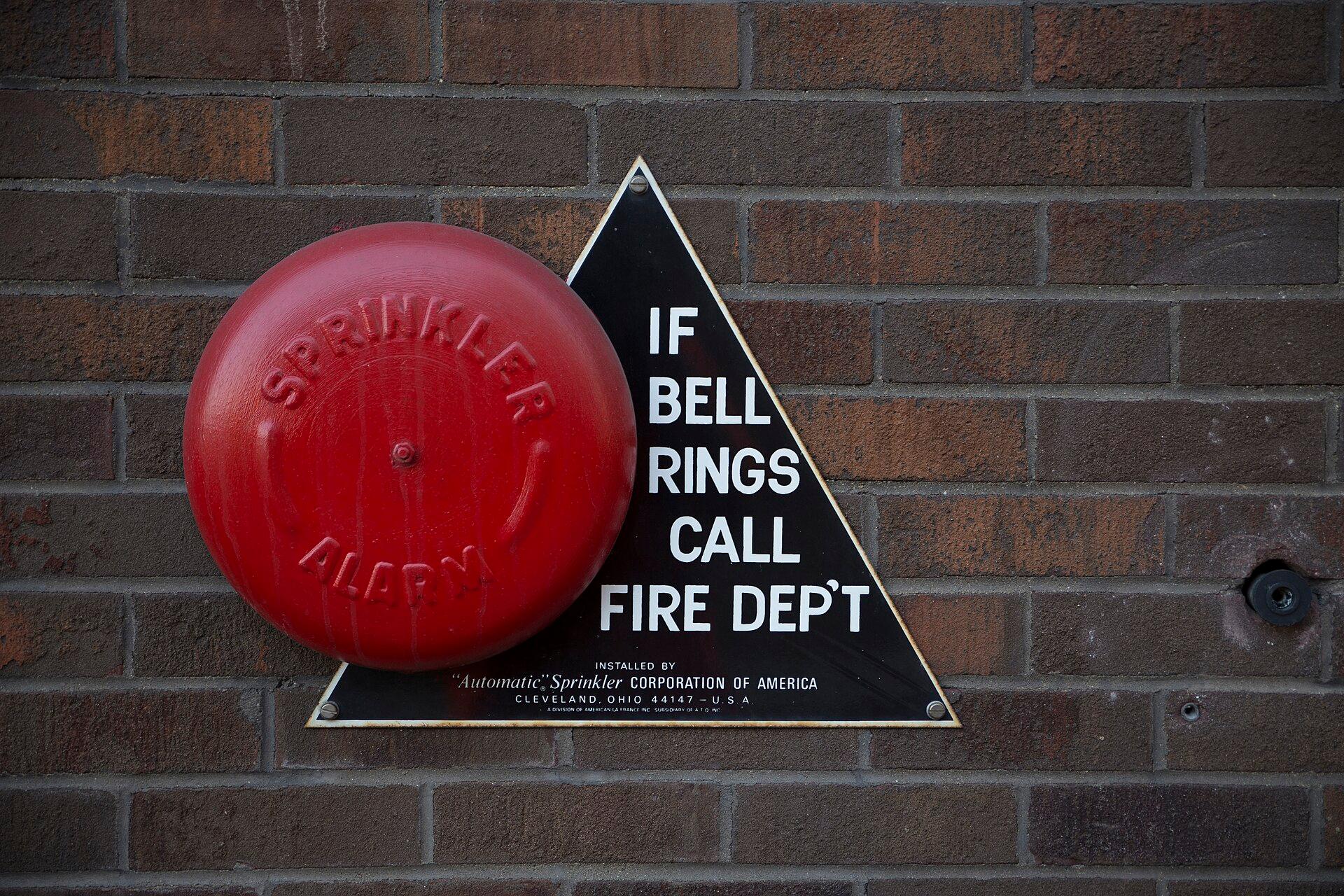
The technician opens a test connection so water flows through the alarm line. What should happen next depends on how the building was built, but it is not optional colour. A water motor gong — the round, often red, mechanical alarm on the outside of a valve room or stair — should sound as water drives its motor. A pressure switch on the same line should change state and raise the fire indicator panel, and from there any brigade or private monitoring the building uses. Many Australian systems have both. The weekly test should prove whichever path is installed, not whichever path is convenient.
If the gong is seized, painted solid, or missing its striker, that is a defect even if the panel still beeps. If the pressure switch has been isolated at the panel “because it keeps going off on tests”, that is not a fix. It is an impairment. Electronic alarms do not make the mechanical gong a museum piece if the gong is still part of the as-installed system.
The visit should also confirm that the main control valve is open, secured and in the position the block plan claims, that gauges are readable, and that the valve room has not become a furniture store. A weekly test that never leaves the test drain is only half a weekly test.
Tenants will hear it. A water motor gong is meant to be loud. Monitoring centres may call. That is the system working. The alternative is an alarm path that has not been proved since the last real activation, which on most buildings is never.
Pump tests: weekly, monthly and beyond
Not every sprinkler system has a pump. Town-main supplies still need pressure and flow checks. Where there is a pumpset, AS 1851 treats diesel and electric drivers differently because they fail differently.
Diesel fire pumps are commonly started weekly. The point is to prove that the engine will crank, run, and that batteries, fuel, coolant, heaters and the controller are in a state to do it again at 2 a.m. A diesel that sits for a month in a Brisbane plant room is not being rested. It is being allowed to flatten, gum or cook. Weekly runs are noisy. They are also the difference between a pump that exists on a drawing and a pump that will start.
Electric pumps are often on a monthly rhythm for a start test, with more thorough runs at longer intervals. An electric pump that has not been started because “it is on auto” has not been tested. Auto is a selector position. It is not evidence.
Monthly work typically includes a harder look at the water supply: tank levels and alarms, suction conditions, jockey or pressure-maintenance pump behaviour, town-main pressure against the baseline, and whether the pump started at the pressure the settings require. Pump start pressures belong on the report, not only in the technician’s head. If the jockey is cycling every few minutes, you have a leak or a drain that was not shut. If the main pump is starting on a pressure that no longer matches the design, you have a settings or supply problem, not a mystery.
Yearly pump work goes further: longer runs, flow where the standard requires it, controllers, and a comparison against commissioning data. None of that is a substitute for the weekly diesel start you skipped because the neighbours complained. If noise is a genuine occupancy problem, the answer is a better enclosure or a conversation with the building, not a private amendment to AS 1851.
Pumps also get left in the wrong mode after a test. The restoration step — selector back to auto, fuel valves open, isolation valves open, alarms reset, monitoring on — is as much the test as the start. A pump proved at 7 a.m. and left on off is in worse condition than a pump that was never visited.
Six-monthly and yearly surveys
Surveys are where the ceiling is allowed to speak. The technician is looking for the defects that weekly gauges cannot see: painted or loaded heads, storage in the discharge pattern, missing escutcheons that hide a painted plate, corrosion, mechanical damage, undocumented isolations, obstructed boosters, missing spare heads, and occupancy that no longer matches the design.
Six-monthly surveys typically cover a defined portion of the installation so the whole system is seen on a cycle. Yearly surveys are the broader pass, tied to the records that occupancy certificates and the AFSS will later rely on. The exact split is in AS 1851. The practical point for a manager is that someone competent has to walk the floors, not only the plant room.
A survey that “could not access the tenancy” is incomplete. Record it as incomplete. Do not let it be filed as a pass. Paying for after-hours access, a lift, or an escort is part of the frequency, as the AS 1851 piece argues. The common reasons surveys fail are collected in common fire sprinkler defects.
Surveys should also pick up interface faults: flow switches that do not report to the panel, valve tamper switches that have been taped, a booster connection buried behind a new bin store. Sprinklers are a wet system with an electrical and a brigade face. Testing only the wet face is how buildings discover, during a real fire, that nobody was called.
What tenants should expect on test day
A well-run building tells tenants when tests will happen. Weekly alarm tests are short. People will hear a gong or a panel buzzer. Water may discharge to a drain. Pumps will start. In a tower, a test that is always a surprise trains occupants to ignore alarms. That is a life-safety problem dressed up as courtesy.
Tenants should not be asked to “turn off” anything on the sprinkler system. They should not hang washing from heads, store hard against the ceiling, or paint fittings. They should report leaks, damaged heads and mystery tags. If a floor is to be isolated for a fitout, that is a planned impairment with a competent person, not a job for the painter. See isolating, draining and restoring a sprinkler system safely.
Building managers should expect, after each visit, a record that states what frequency was performed, what was found, what was left outstanding, and whether any part of the system is isolated or impaired. “Attended, all ok” is not a test record. Pressures, pump mode on departure, and any area not accessed should be on the page.
The calendar is not the interesting part of AS 1851. The interesting part is whether the visit you paid for was the visit the standard described. Weekly for the alarm path. Weekly or monthly for the pumps, depending on the driver. Six-monthly and yearly for the installation you actually have, not the one on last decade’s drawing. That is the servicing rhythm. Everything else is an invoice title.