Choosing a fire sprinkler contractor is not the same exercise as choosing a plumber who can hang copper. The work is licensed in most Australian jurisdictions, it is designed to AS 2118 rather than to a sketch, and the system has to be maintainable under AS 1851 for the life of the building. A cheap first fix that cannot be certified, or that cannot be handed over to a service contractor, is not a saving.
This guide is for owners, project managers and facility managers letting commercial and industrial work — warehouses, shops, towers, plant rooms. It sits in the commercial and industrial hub next to the occupancy pieces because the right contractor is the one who has done this hazard before. Who may design and certify is a related but different question; this page is about the firm that will put pipe in the air and leave you a system you can keep.
What licence a sprinkler installer needs
Licensing is state-based. There is no single national “sprinkler ticket” that you can glance at and file.
In New South Wales, fire-protection work is licensed through Fair Trading, with classes that distinguish inspect-and-test from install-and-maintain, and with accreditation schemes that sit over some of that work. In Victoria, fire-protection practitioners are registered with the building regulator in defined classes of work. In Queensland, the QBCC issues occupational licences for fire protection, again split by the type of work. Western Australia, South Australia, Tasmania, the ACT and the Northern Territory each have their own contractor or building-practitioner frameworks. The detail changes; the method does not. Ask for the licence number and the class, and look it up on the public register for the state in which the building sits.
A plumbing or mechanical licence is not automatically a fire-sprinkler licence. Some jurisdictions fold limited fire work into other licences; most do not let a general plumber certify a sprinkler install. Labourers on a licensed contractor’s crew do not need to each hold the company licence, but the supervising licensee has to be real, and the work has to stay inside the class. Interstate contractors working on a Queensland warehouse or a Victorian tower need the local authorisation, not a photocopy of a home-state card.
Insurance is the next document. Public liability should be in force for the contract value and the occupancy (a supermarket fitout is not a chemical warehouse). If the firm offers design, they need professional indemnity that actually covers fire-services design, not a policy written for residential drafting. Contract works and plant insurance matter on a live site. Ask for certificates of currency, not a sentence in a tender.
Design versus install
Australian projects split in two common ways.
Separate design and install puts a fire engineer or hydraulic designer behind the drawings and calculations, and a licensed installer behind the pipe. The designer’s professional indemnity sits on the numbers; the installer certifies that the install matches. This is often the cleaner arrangement on high-rise pressure zones, high-piled storage and anything with a performance solution, because the person who chose the density is not also the person who has to make the quote fit.
Design-and-construct puts both in one firm. It can be entirely competent. Many of the better Australian sprinkler contractors design, hang, commission and service their own work. The test is whether they produce hydraulic calculations, listed heads, a zone plan and a certifiable as-built, or whether “D&C” means a sketch, a price and a handshake. If the same firm will also maintain the system, ask how defects they installed will be reported under AS 1851. Self-review is not forbidden; unrecorded self-review is.
What you should not do is leave a gap. An architect’s ceiling plan is not a sprinkler design. A builder’s instruction to “match existing” is not a calculation. The installation process only works if someone owns the design basis — commodity, hazard, water supply, pressure zone — in writing.
Insurance, references and similar hazard
Ask for completed buildings that look like yours. A contractor who has spent a decade doing office and retail tenancies is not thereby an ESFR warehouse contractor. A warehouse crew is not thereby a high-rise PRV and high-zone pump crew. Kitchen wet-chemical coordination, pre-action data halls and transformer deluge are special-hazard experience, not a variation line.
Referees should be people who own or manage the finished system, not only the builder who wanted the cheapest program. Ask whether the as-builts arrived, whether the spare-head box was stocked, whether weekly tests were demonstrated, and whether the first year of defects was argued about. Then, if you can, walk a live job. Valve-room housekeeping, labelled isolations and a block plan that matches the pipe are better evidence than a safety slogan on a ute.
For storage occupancies, ask what commodity, pallet type and storage height the reference job was designed for. For towers, ask who designed the pressure zones and who holds the PRV listing. For shops, ask how they manage after-hours isolations with centre management. Similar hazard means similar questions.
Spare heads, as-builts and maintenance handover
A finished sprinkler contract has a paper and hardware tail. If the quote does not include it, you will buy it later from a service contractor who was not there.
Spare heads. A cabinet, in a known location, with spare heads of each type and temperature rating used, a wrench, and a stock list. After a fire or an accidental operation you should be able to replace a head without waiting a week for an indent. Painted or mystery heads in a jam jar are not a spare kit.
As-builts and the block plan. Drawings that show what was hung, not what was tendered. Floor plans with head locations, isometric or schematic risers, isolation valves, pumps, tanks, booster inlets, and the design basis (hazard, density or listing, water supply). The block plan at the fire-indicator panel and at the booster has to match those drawings. Brigade officers and after-hours technicians should be able to isolate a floor without guessing.
Certificates and calculations. The installer’s certificate, the designer’s certificate where separate, pump and tank data, backflow, commissioning records, and the hydraulic calculation that belongs to the as-built system. “Calcs on request” after practical completion is how numbers go missing.
Maintenance handover. AS 1851 does not begin at the first invoice. It begins when the installer shows the owner’s service contractor the alarm valve, the weekly test, the isolation register, the spare heads and the defects that were outstanding at handover. Read AS 1851 sprinkler maintenance before you sign a practical-completion certificate that says “owner to arrange maintenance.” If you want one firm to install and service, put the first year’s AS 1851 in the install contract so the people who know the valve room are the people who test it.
Red flags
Some warnings are cheap to spot and expensive to ignore.
Cash isolations. Anyone who will close a sprinkler valve for cash, after hours, without a permit, without notifying the monitoring centre, and without a restoration test, will also leave it closed. Shopping centres and multi-tenant offices see this. It is not a commercial arrangement. It is how buildings burn with a certified system sitting dry.
Painted heads. Paint on a bulb, a fusible link or a cover plate is a defect. A contractor who hangs heads and then lets the painter “cut in” around them, or who spray-paints a ceiling with the plates in place, does not understand the listing. So does a contractor who replaces a concealed plate with a generic disc from a lighting supplier.
No calculations. A lump-sum install with “pipe sizes as per standard” and no hydraulic calculation is not an AS 2118 design. This is especially dangerous on storage, on long ranges, and on anything taking water from a weak main. If they cannot show the numbers, they do not have a design.
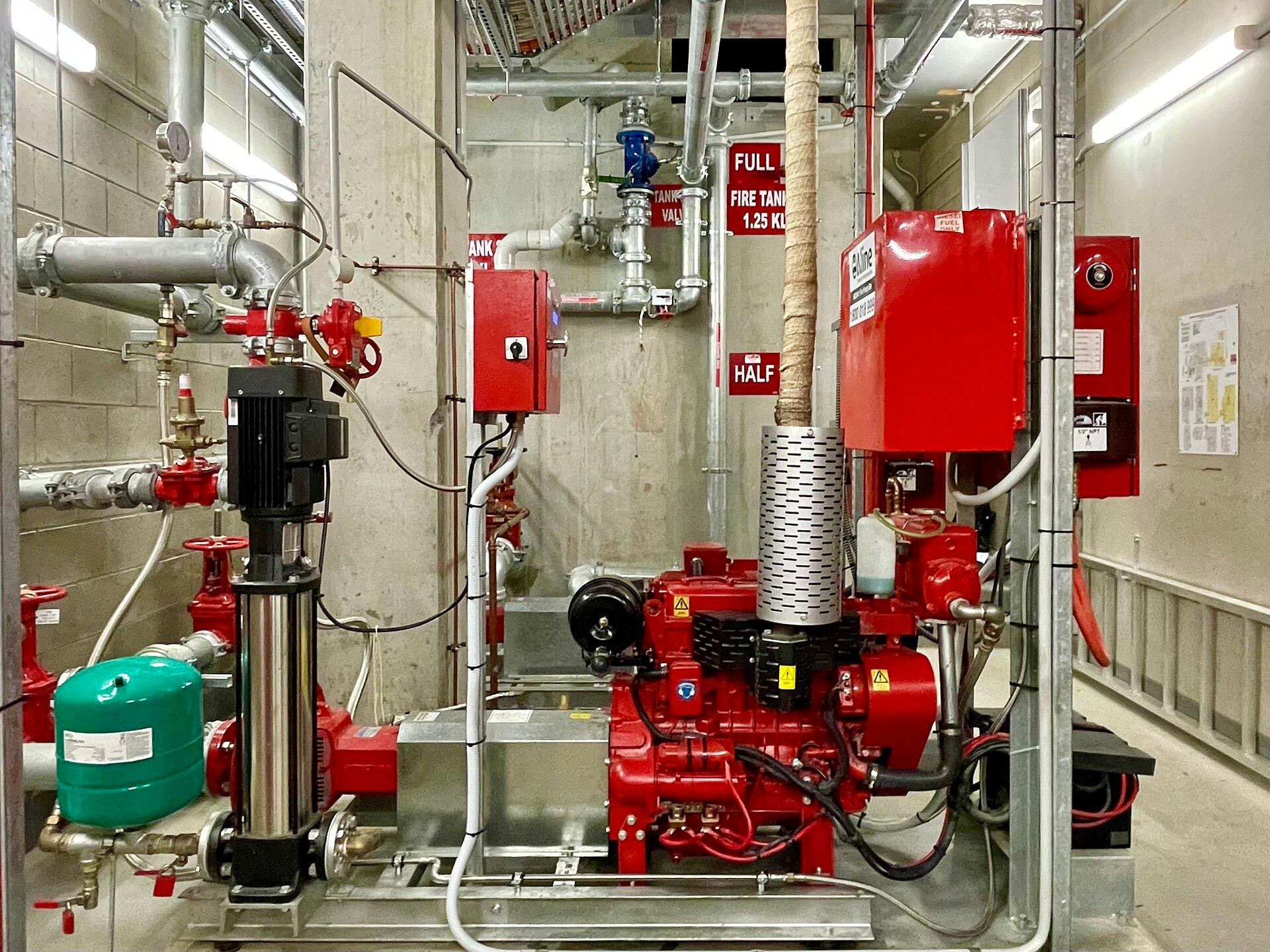
No water-supply story. Pumps and tanks copied from the last job, a diesel set with no fuel or no exhaust path, a town-main connection that the water authority has not approved, or a booster that an appliance cannot stand at: all of these are contractor-selection failures as much as design failures. The photograph on this page is a real Australian diesel hydrant pump. Your building may need one. It should not be a surprise at commissioning.
Unlabelled valves, missing spare heads, and “we’ll do as-builts later.” Later means never. Put the handover deliverables in the contract as a condition of the last claim.
A competent contractor is licensed for the work, insured for the occupancy, practised on similar hazard, willing to show calculations, and organised enough to leave you a valve room that a stranger could test next week. That is a higher bar than a friendly price. It is also the only bar that matches what the NCC thought it was getting when it required the system.