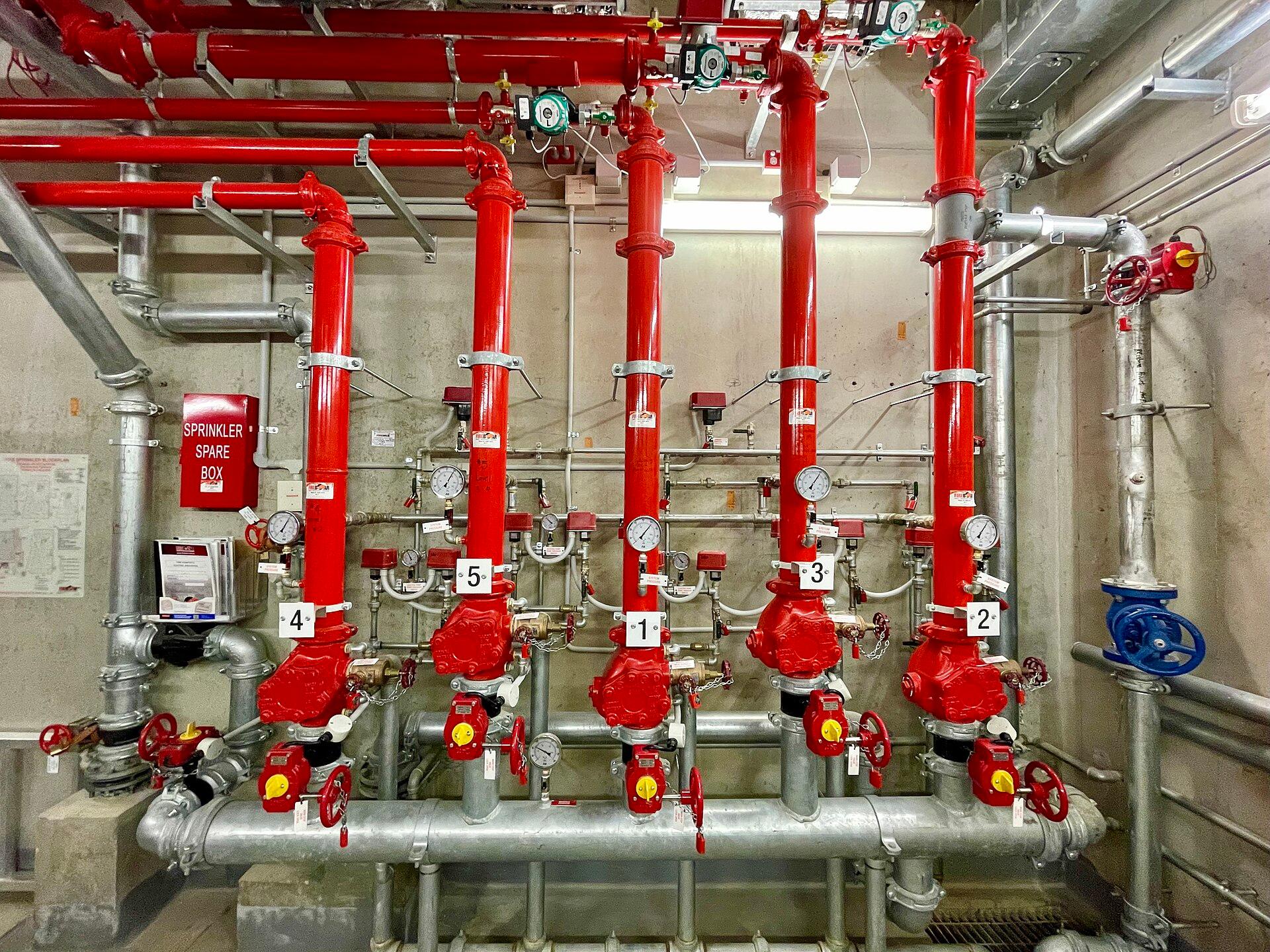
Heads and pipe get the attention. Whether water arrives is decided upstream of the alarm valve: the town main, the authority’s conditions, the tank and the pump set. I have walked through finished installations where the ceiling looked complete and the supply was still a hope. This is the part of installation and design that a residual-pressure graph either blesses or kills.
Australian water authorities are not a single utility. Each has its own rules about fire connections, meters, backflow prevention, and whether they will acknowledge a sprinkler demand on a residential street. The hydraulic calculation states what the system will ask for. The authority, and the physics of the main, decide whether the street will give it.
Can I use the domestic water main?
Sometimes. “Domestic” here means the potable service that already enters the site, not a garden tap. For a small FPAA101D, 101H or AS 2118.4 system in a house or low-rise residential building, a dedicated fire service off the town main — correctly sized, with the required backflow prevention — can be enough if the residual at the calculated flow still sits above the demand. That is a documented test, not a kitchen tap that still hisses when the dishwasher is on.
A commercial or industrial system is a different demand. Ordinary-hazard and storage densities pull litres that a 25 mm or 32 mm domestic meter will not pass without collapsing the residual. Authorities also restrict or refuse new fire services on marginal mains, or require a reduced connection that is useless for the remote area. Some allow a sprinkler draw only if a tank is interposed so the street sees a controlled fill rather than a sudden fire flow.
Two rules save arguments. Do not tee the sprinkler riser into the domestic plumbing. Do not treat a Sunday-morning static reading as a supply. Ask for a residual test at or above the design flow, plotted as a graph, and read the authority’s current fire-service conditions before the tank is deleted from the budget.
Where the street is honest and the demand is modest, a town-main supply is the cheapest reliable answer: no diesel to test, no tank to keep full, no pump room to ventilate. It also has no patience for a later warehouse fitout that doubles the remote-area flow. If the use can change, design the connection so a tank can be added without demolishing the riser.
When a suction tank is required
A tank appears when the town main cannot, or will not, support the demand for the required duration. Inadequate residual, an authority that refuses a direct fire draw, a site at the end of a long rural main, a high-rise that must not depend on street pressure in every zone, or a dual-supply rule that wants a source independent of the street — those are the usual triggers.
The tank is sized for the sprinkler demand, plus any hydrant share the design has accepted, for a duration that matches the hazard. That duration is the period in the adopted method, not “until the brigade arrives”. Undersizing the tank to fit a tight plant compound is how a system runs out of water while heads are still open. Effective capacity is the volume between the low-level suction limit and the overflow, not the litres painted on the side. Vortex plates, strainers and the level at which the pump loses prime all steal volume.
Suction arrangements matter as much as litres. Flooded suction — water above the pump — is the Australian preference because it starts reliably. A suction lift is a different problem of priming and reliability. Tanks need safe access, an overflow that will not flood a neighbour, a fill that can recover after a test, and freeze or algae protection appropriate to the climate.
Dual supplies are a standards conversation, not a slogan. Larger or higher-risk buildings may need two independent sources — two mains, a main and a tank, or two tanks — so a single street shutdown or tank failure does not silence the system. Two pipes off the same dead-end main are one supply with extra fittings.
Electric or diesel fire pump?
If the tank or the residual cannot put the required pressure at the alarm valve, you need a pump. The Australian pump-set conversation is still electric versus diesel, and often both.
An electric pump is compact, quiet and cheaper to install. It needs a supply that will still be there when the rest of the floor has been isolated, and a starter and controller that meet the pump-set standard — in general terms, AS 2941 territory. If site power is a single incoming supply with no generator backing the fire board, an electric-only arrangement is a bet that the fire and the blackout will not arrive together. A hospital, a high-rise, or a site that loses power in storms usually cannot take that bet.
A diesel pump carries its own energy. It starts from batteries, runs on a maintained fuel tank, and keeps going when the incoming mains are dead. It also needs combustion air, exhaust, cooling, a start regime, fuel that is actually in the tank, and a plant room that can handle noise and fumes. Diesel is not automatically “more reliable”. A set that has not been started, or that sits with a dead battery and stale fuel, is a sculpture.
The common Australian answer on a serious supply is one electric and one diesel, each able to meet the duty. Smaller tanks and residential-style systems may have no pump, or a single electric booster, if the hydraulics and the authority allow it. Match the pump to the risk, not to the brochure.
Pump rooms are part of the design: drainage so a leak does not flood the controller, lighting and access for a 3 am attendance, ventilation for a diesel, acceptable fuel storage, and space to pull a pump. AS 2941 is specific about controllers, sensing lines, starting devices and test flow. A pump on a slab in a corridor is not a pump room.
Jockey pumps and pressure maintenance
The jockey — a pressure-maintenance pump — is the small pump everyone forgets until it short-cycles. Systems leak a little: a grooved coupling weeps, a gauge drips, temperature nudges the pressure. Without a jockey those losses drop the system onto the main pump’s start pressure, and a diesel comes over for a cup of tea.
The jockey holds a band above the main-pump start pressure. A switch starts it on a small drop and stops it when the band is restored. If it runs continuously, you have a leak large enough to find. If it never runs and the main pump starts on every minor drop, the band is wrong or the jockey is dead. Weekly attendance should look at the hours-run meters, not just whether the skid is painted.
Low-pressure and pump-running signals go to the fire indicator panel. A jockey isolated “because it was noisy” is a common AS 1851 defect. So is a closed sensing-line valve that leaves the controller staring at a frozen gauge. Treat the small pump as part of the system, not as an annoyance in the Brisbane plant room in the photograph above.
Shared tanks and the dual-risk problem
Many Australian sites store sprinkler water and hydrant water in the same tank. The saving is real: one excavation, one liner, one fill. The risk is also real. A hydrant flow at the booster, a leaking landing valve, or a test that no one topped up will lower the water the sprinkler pumps think they have. If the tank was sized as the sum of both demands for the full duration, and low-level alarms leave each system its volume, the arrangement can be honest. If the tank was sized for the sprinklers and hydrants were added later, it is a shared failure waiting for Friday.
Designers who do this well separate capacity, suction and signalling. Capacity must cover the demand the adopted method requires — hydrants and hose reels are not a rounding error. Suction should be arranged so a hydrant draw does not uncover the sprinkler suction. Level switches should tell the fire indicator panel that the shared volume has been eaten, not wait until a pump cavitates. Some sites still prefer a baffle or a separate compartment.
Town-main restrictions make shared tanks more common. An authority that will not support two large fire services will happily support a trickle fill into one tank. That is not a reason to hide the dual risk in a single float. Write the shared assumption on the block plan, the hydraulic summary and the owner handbook.
The supply is the system. A ceiling of concealed heads over an empty tank is decoration. Ask for the residual graph, the tank effective capacity, the pump duty against the demand point, and the story of what is shared with the hydrants. If those four things cannot be produced, the rest of the design is still a drawing.